
What the Pasco County Court Handles
Florida runs a two-tier trial-court system. The County Court sits on the lower tier, and the Circuit Court sits above it. The Pasco County Court is a court of limited jurisdiction, which means a statute spells out exactly what kinds of cases it may hear. It does not take felonies, divorce, probate, or guardianship. Those move up to the Circuit Court. What the County Court does take is the high-volume, lower-stakes work that touches the most people: traffic tickets, small money disputes, misdemeanor crimes, and code violations.
Five broad case groups run through the Pasco County Court. First are misdemeanors, the lower-level crimes such as a first-time DUI charged as a misdemeanor, petit theft, or simple battery. Second is county civil, money suits within the court's statutory dollar cap. Third is small claims, the simplest civil track for the smallest disputes. Fourth is traffic, both civil infractions and criminal traffic. Fifth are ordinance cases, where a county or city rule has been broken. Each of these maps to a court-type code in the Clerk's online search.
The County Court is a workhorse. More cases pass through it than through the Circuit Court, simply because traffic and misdemeanor volume is so high.
Pasco County Court Locations
The Pasco County Court does not sit in its own building. It shares the same two judicial centers that the Circuit Court uses. East Pasco cases are heard at the Robert D. Sumner Judicial Center in Dade City. West Pasco cases are heard at the West Pasco Judicial Center in New Port Richey. Both sites handle hearings, jury duty, trials, traffic tickets, fines, and restitution. A defendant should report to the center named on the court notice, not pick the nearer one.
Stored and older county-court files are kept at separate records-retention buildings, not at the courtroom counters. So a person going to a hearing and a person pulling an old file may need two different addresses on the same side of the county.
Robert D. Sumner Judicial Center
38053 Live Oak Avenue
Dade City, FL 33523
(352) 521-4542
West Pasco Judicial Center
7530 Little Road
New Port Richey, FL 34654
(727) 847-8031
Note: court hearings and traffic matters use the judicial centers, while older county-court file viewing is routed to the East Pasco and Jack Albert records-retention facilities.
Pasco County Court Judges
County judges, not circuit judges, preside over the limited-jurisdiction docket. The Sixth Judicial Circuit "About the Circuit" page states that seven county-court judges preside over cases in the two Pasco judicial facilities in Dade City and New Port Richey, alongside fifteen circuit judges. Across the full Sixth Circuit, which also covers Pinellas County, the page reports twenty-four county judges in all.
A county judge runs traffic court, hears misdemeanor pleas and trials, decides small claims, and rules on county civil and ordinance matters. The same judge may also handle first appearances and other duties the chief judge assigns. The Sixth Judicial Circuit homepage links to current judge assignments, divisions, and court programs for both counties.
County Court vs Circuit Court in Pasco County
The split between the two courts comes down to jurisdiction. The County Court has limited jurisdiction set by statute. The Circuit Court has general jurisdiction, which is the broad default for anything not handed to the County Court. The dollar cap for county civil and small claims, and the line between misdemeanor and felony, are the practical dividers. Knowing which court holds a case also tells you which court-type code to use in the online search.
| Pasco County Court | Pasco Circuit Court | |
|---|---|---|
| Jurisdiction | Limited, set by statute | General |
| Criminal | Misdemeanors (MM), criminal traffic (CT) | Felonies (CF) |
| Civil dollar range | Lower-value county civil (CC) and small claims (SC) | Higher-value circuit civil (CA) |
| Family & probate | No | Yes (DR, CP, GA) |
| Traffic & ordinance | TR, IN, CO, MO | No |
| Appeals | Decisions appealed up | Hears county-court appeals (AP) |
For the upper-tier side of this split, see the Pasco County Circuit Court page. Small claims and county civil cases that grow past the statutory cap can end up refiled or transferred to the Circuit Court.
Pasco County Court Case-Type Codes
Every Pasco court case carries a two-letter court-type code inside its case number. The Clerk's online search uses these codes both as a filter and as part of the case-number format. The codes below are the ones that fall to the County Court tier. They appear in the same checkbox and dropdown list that the search portal shows for all Pasco cases, so knowing the County Court subset helps narrow a search fast.
| Code | Court Type |
|---|---|
| MM | Misdemeanor |
| CC | County Civil |
| SC | Small Claims |
| CT | Criminal Traffic |
| TR | Traffic Infraction |
| IN | Non-Criminal Infraction |
| CO | County Ordinance |
| MO | Municipal Ordinance |
The felony (CF), circuit civil (CA), family (DR), probate (CP), and guardianship (GA) codes belong to the Circuit Court, not the County Court. The appeal code (AP) is its own special case, covered further down.
How to Search Pasco County Court Cases
County-court cases are searched through OCRS, the Online Court Records Search the Pasco Clerk and Comptroller runs on the Civitek Florida platform. The same portal covers both trial-court tiers, so there is no separate County Court search tool. A user just filters by a County Court code such as MM, SC, or TR to keep the result list focused on the lower tier.
Start at the Pasco County OCRS entry page, which opens with a Public access button and a notice citing Florida AOSC 15-18. Public mode is anonymous and free. Attorney mode is only for attorneys of record and needs a login, so most people should choose Public.
- Open the Pasco OCRS entry page and click Public.
- Read the disclaimer and click I Agree to reach the search form.
- Use Person Search with a last name or a business name when you do not have a case number.
- Under Court Type, check County Court codes such as MM, CC, SC, CT, TR, IN, CO, or MO to limit results.
- Use Case Search when the full case number is known; enter the year, the court-type code, and the six-digit sequence.
- Open a result to view the docket; for a certified copy, order through the Clerk's Court Records desk.
For deeper search help and the full field list, see the Pasco County court records and court dockets pages.
Traffic Cases in the Pasco County Court
Traffic is the largest single block of County Court work. It splits into two halves. Civil traffic infractions (TR) and non-criminal infractions (IN) are the speeding, red-light, and similar tickets that carry fines and points but not jail. Criminal traffic (CT) covers more serious driving offenses, such as driving on a suspended license or a misdemeanor DUI, and rides closer to the misdemeanor track.
Florida lets eligible civil traffic cases be heard by a traffic hearing officer rather than a county judge. A traffic hearing officer handles contested civil infractions only, not criminal traffic. The officer can find the driver liable or not, set the civil penalty, and order driver-improvement school where the law allows. For citation lookup, payment options, and the line between the court file and your state driver record, see the Pasco County traffic court records page.
Note: A mandatory-appearance criminal traffic case such as a DUI cannot be cleared by paying online like a waivable civil infraction.
Domestic Violence Injunctions
Domestic violence injunctions, sometimes called restraining orders, are filed through the Pasco Clerk and follow the procedure in Florida Statutes 741.30. The petition asks a judge for protection, and a temporary order can be entered the same day before a full hearing is set. While the underlying injunction is a circuit-level matter, the County Court tier interacts with it because a violation of an injunction can be charged as a misdemeanor and land back in front of a county judge.
The official statute text sits on the Florida Senate site. The screenshot below is the linked source.
The full procedure appears at Florida Statutes 741.30 on the state legislature site.
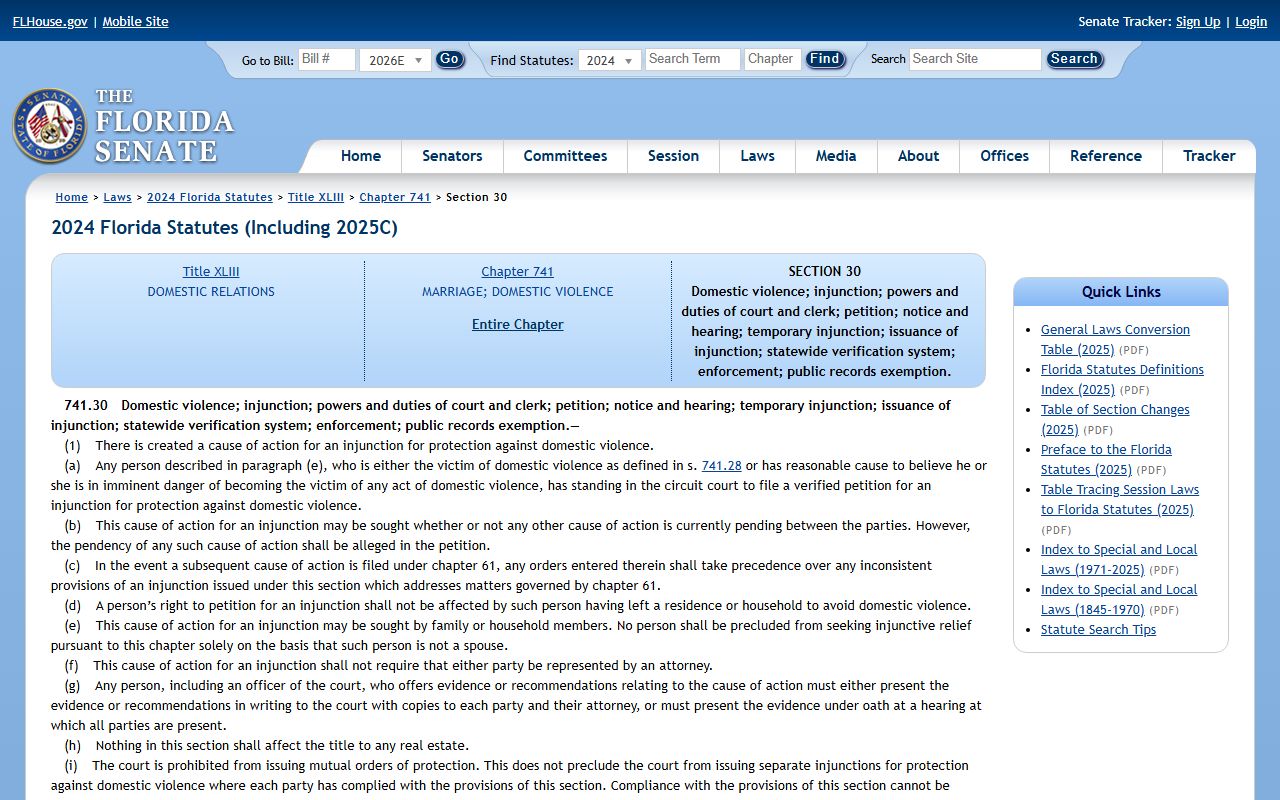
That statute spells out who may file, what a petition must show, and how a temporary and a final injunction work, which is why a Pasco filer should read it before going to the Clerk.
Appeals From the Pasco County Court
A party who loses in the County Court usually does not jump straight to a District Court of Appeal. Instead, the first level of review for most county-court decisions is the Circuit Court sitting in its appellate role. The Clerk tracks these matters under the AP court-type code, "Appeal from County Court." That code is one of the search options in OCRS, so an appeal can be looked up the same way a trial case is.
The flow is short and worth knowing before filing. A notice of appeal starts the clock, the record goes up from the County Court, and a panel of circuit judges reviews it.
- County Court enters a final judgment or order.
- The losing party files a notice of appeal within the deadline.
- The case is docketed under the AP code in OCRS.
- The Circuit Court reviews the county-court record on appeal.
- Further review may go to the District Court of Appeal in limited cases.
Appeal flow: Pasco County Court › Circuit Court (appellate review, AP) › District Court of Appeal (limited) › Florida Supreme Court
Pasco County Court Records and Confidentiality
Most county-court files are open to the public under Florida's broad public-records tradition. Some are not. Certain juvenile criminal history records carry retention and automatic-expunction rules, set in Florida Statutes 943.0515, and juvenile justice records more broadly are guarded by Florida Statutes 985.04. Those rules can pull a record out of ordinary public view even when it ran through a lower court.
The juvenile expunction statute is the source for the retention timelines that affect what stays searchable.
Read it directly at Florida Statutes 943.0515 on the Florida Senate site.
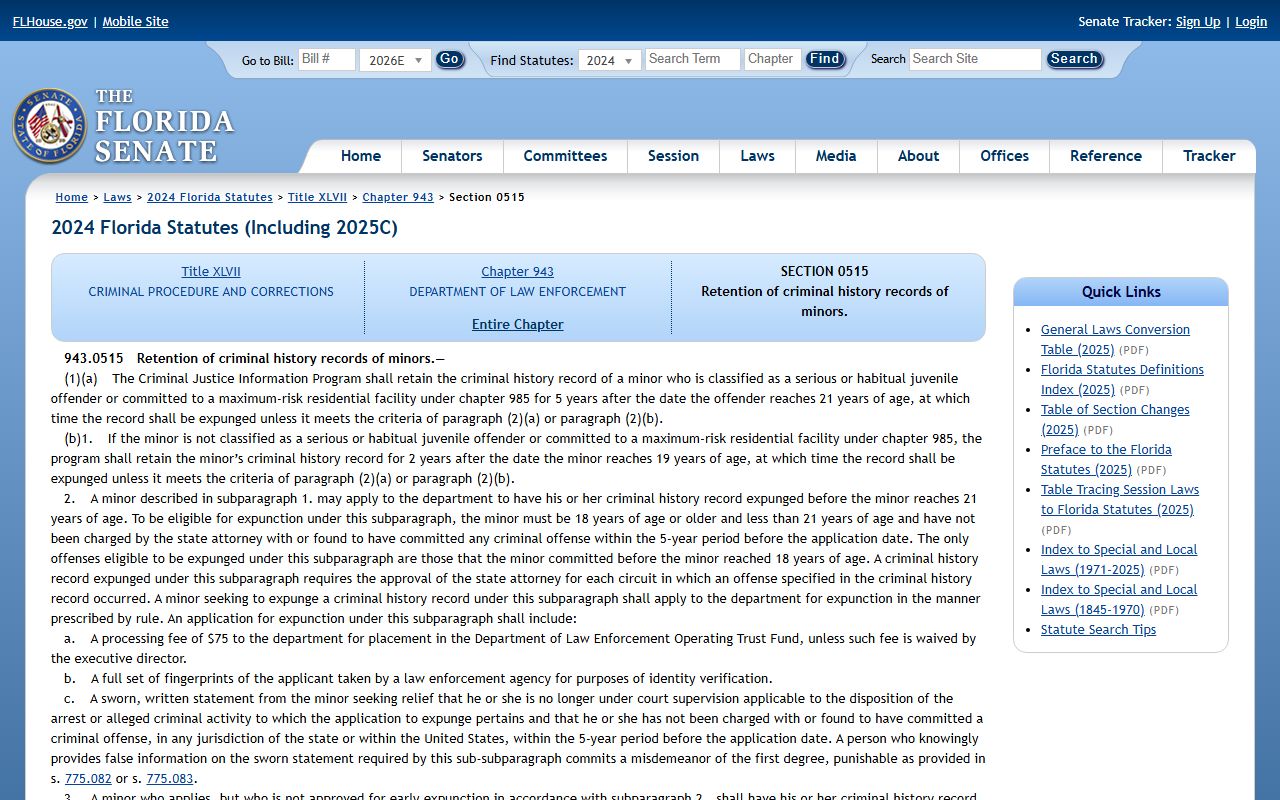
That statute explains when certain juvenile criminal histories are kept and when they are automatically wiped, which shapes whether a person finds a record at all.
The companion juvenile-records confidentiality rule is just as important for County Court work. The Florida Senate hosts its full text.
See Florida Statutes 985.04 for the juvenile justice records framework.
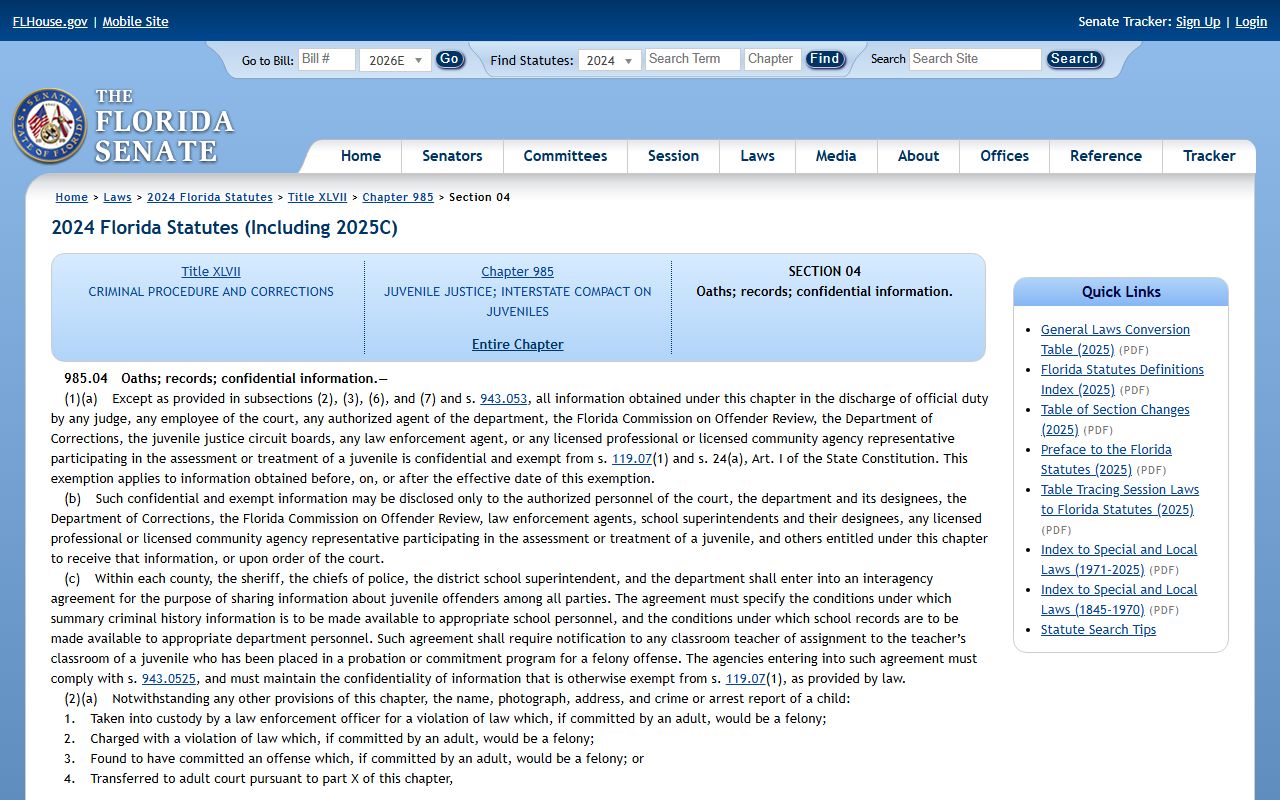
Read together with the expunction statute, it draws the line between what a parent, agency, or attorney may access and what stays off the public docket. For adult misdemeanor records and arrest history, see the Pasco County criminal records page.