
How to Search Pasco County Court Records
The main public tool for Pasco court cases is OCRS, the Online Court Records Search hosted by Civitek Florida for the Pasco Clerk and Comptroller. It opens with an access-choice screen. Anonymous users pick the Public mode. The Attorney mode is a separate path that needs a user ID and password, and it is built for attorneys of record who want to see their own cases. Both tracks land on the same search form once a short disclaimer has been read. The system reaches civil, family, criminal, probate, guardianship, and traffic cases at the Circuit Court and the County Court level.
Before starting, have a last name, a business name, or a full case number ready. Public OCRS will not run with no name and no case number. A date-of-birth field is there to help narrow common names. The choice page also posts a notice that all online access is governed by Florida AOSC 15-18.
The first screen is the Pasco County OCRS access-choice page, which shows the Public and Attorney buttons and the AOSC 15-18 notice. The screenshot below shows that entry layout.
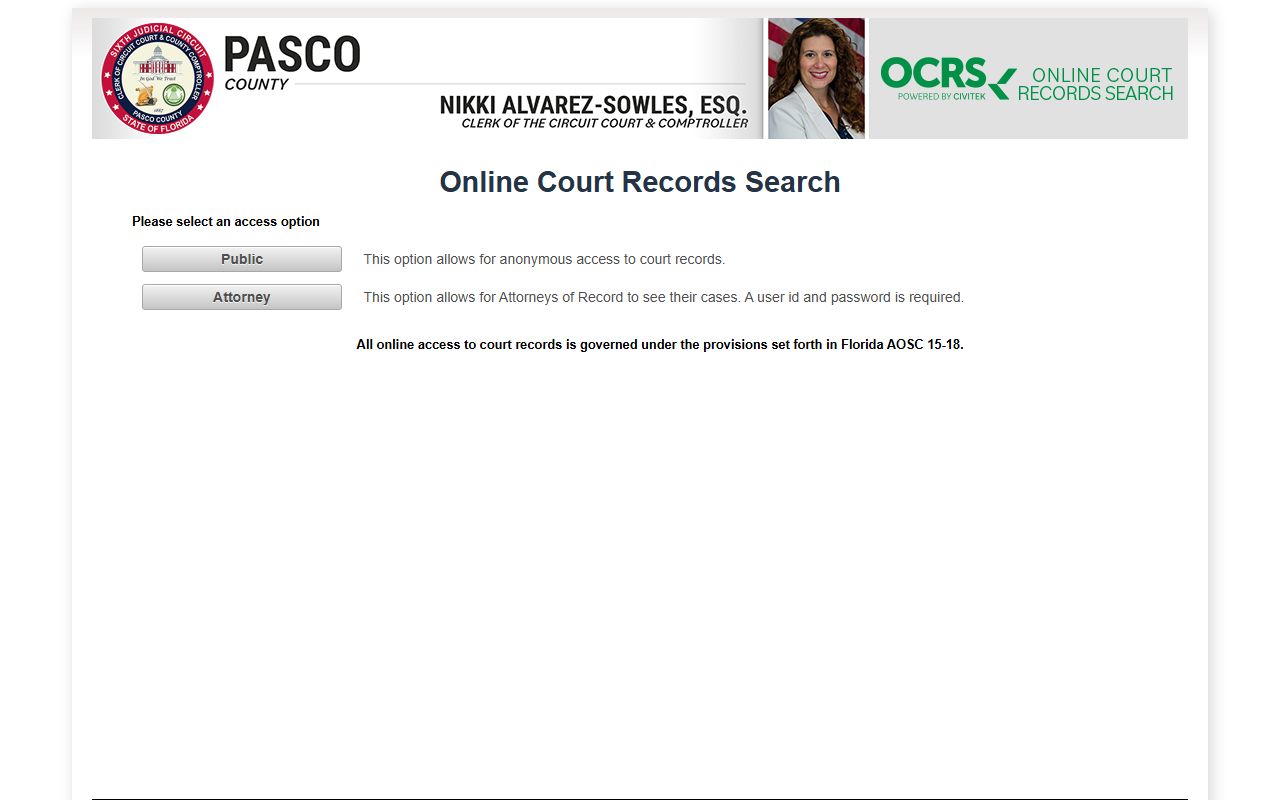
Clicking Public sends the visitor to a one-time disclaimer screen before the search form opens. The steps below run from the entry page through a finished search.
- Open the Pasco OCRS access page and click Public for anonymous lookup, or Attorney if you have credentials.
- Read the disclaimer screen and click I Agree to reach the search form.
- Use Person Search when only a name is known. Enter at least a last name or a business name.
- Use Case Search when the full case number is known. Enter the four-digit year, pick the court-type code, and enter the six-digit sequence number.
- Add filters such as Date Case Filed From and To, date of birth, or Court Type to cut the result list.
- Open a result to view the docket. For certified copies, place an order through the Clerk's Court Records or Official Records desks.
The OCRS Disclaimer and Public Access Mode
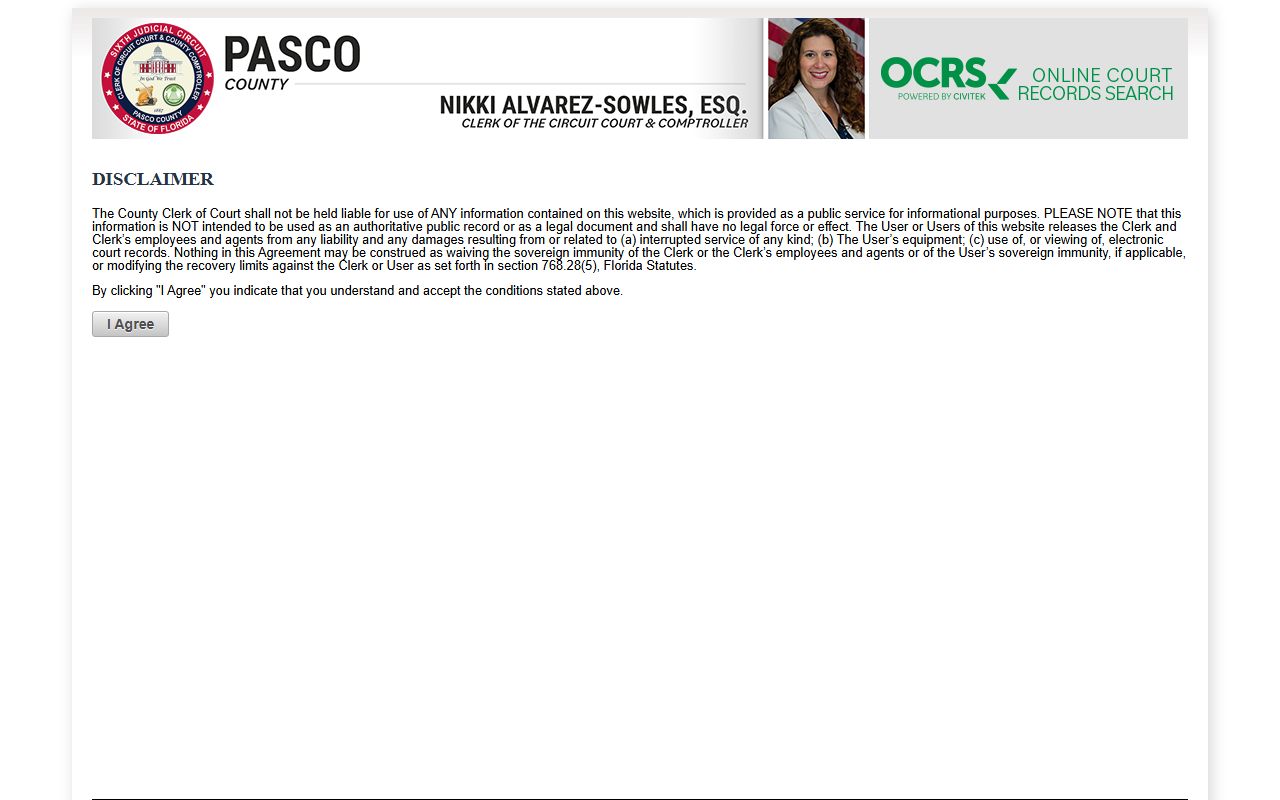
Public access is anonymous, but it is gated. Every public user must pass a disclaimer screen first. The Clerk's disclaimer says the office is not liable for use of the information, that the data is provided as a public service for informational purposes, and that it is not meant to be an authoritative public record or legal document. In plain terms, an OCRS printout has no legal force on its own. The button label is I Agree.
The OCRS disclaimer page must be accepted before any public search runs. The image below shows that screen and its I Agree button.
After you agree, the search form loads with two tabs: Person Search and Case Search. Attorney mode is the other route, and it exists so attorneys of record can pull their own case files with a login. Most members of the public will never need that mode. Full record detail and document availability are still governed by AOSC 15-18, Florida Rule 2.420, and the confidentiality statutes covered further down.
Pasco County Court Records Person Search
Person Search is the right tab when you know a name but not a case number. It works for people and for businesses. The screen-reader help on the form states the rule plainly: provide at least a last name or a business name. Everything else is an optional filter meant to narrow a long result list. The form even spells that out, calling the extra fields filters that reduce results.
The full set of fields that powers a name lookup is part of the OCRS public search form, which holds both the Person Search and Case Search tabs. The screenshot below shows that form.
The table below lists each Person Search field as it appears on the public form.
| Field Label | Type | Required | Notes / Format |
|---|---|---|---|
| Last Name | Text | Yes (for person) | Max 30 characters. Provide at least last name or business name. |
| First Name/MI | Text | No | Max 40 characters. |
| Business Name | Text | Yes (for business) | Max 30 characters. Used instead of last name. |
| Date Case Filed From | Date | No | MM/DD/YYYY format. |
| Date Case Filed To | Date | No | MM/DD/YYYY format. |
| SSN | Text | No | Max 11 characters. Public display is limited and likely redacted. |
| Date Of Birth | Date | No | MM/DD/YYYY. Helps split common names. |
| Court Type | Checkbox group | No | Pick one or more court types from the code list. |
Note: The SSN and date-of-birth fields exist on the form, but Florida confidentiality rules limit what the public version of a record actually shows.
Pasco County Court Records Case Search
Case Search is the faster tab when the full case number is in hand. Instead of a name, it asks for the parts of the number itself. A Florida case number breaks into a year, a court-type code, a sequence number, and two optional pieces. The form prefills the last two fields with a percent sign, which acts as a wildcard. Leave those wildcards in place unless you know the exact party suffix or branch.
The Case Search fields are shown below.
| Field Label | Type | Required | Notes / Format |
|---|---|---|---|
| Year | Text | Yes | Four digits. The year the case opened. |
| Court Type | Dropdown | Yes | Select one code. First option reads "--- SELECT ---". |
| Sequence # | Text | Yes | Up to six digits. |
| Party Identifier | Text | No | Prefilled with "%". Max 4 characters. |
| Branch Location | Text | No | Prefilled with "%". Max 2 characters. |
Both tabs share Search and Reset buttons. If a Case Search returns nothing, double-check the court-type code and the year. A felony filed in one year will not appear under another. If you get too many hits on a Person Search, add a date range or a court type to trim the list.
Pasco County Court-Type Codes
Every Pasco case number carries a two-letter court-type code. The code tells you which kind of case it is and which trial-court tier handled it. The same codes appear in the Person Search checkboxes and the Case Search dropdown. Knowing the right code makes a Case Search much faster and helps you read a docket at a glance.
| Code | Court Type |
|---|---|
| AP | Appeal from County Court |
| CA | Circuit Civil |
| CC | County Civil |
| CO | County Ordinance |
| CT | Criminal Traffic |
| DR | Domestic Relations/Family |
| CF | Felony |
| GA | Guardianship |
| MM | Misdemeanor |
| MO | Municipal Ordinance |
| IN | Non-Criminal Infraction |
| CP | Probate/Guardianship |
| SC | Small Claims |
| TR | Traffic Infraction |
Types of Pasco County Court Records
Pasco court files map to those court-type codes. The Circuit Court of the Sixth Judicial Circuit hears the heavier matters: felony cases (CF), family and divorce cases (DR), probate (CP), guardianship (GA), circuit civil (CA), and injunctions. The Pasco County Court hears the lower-tier matters: misdemeanors (MM), county civil (CC), small claims (SC), traffic, and ordinance cases. The unified Clerk keeps the files for both tiers, so one search covers them all.
Beyond case files, the Clerk also keeps Official Records, a separate index of recorded documents. A final judgment may sit in both worlds: as a docket inside OCRS, and as a recorded judgment inside Official Records. The two indexes share content but use different search forms. The list below covers the main case-record groups.
- Criminal records: Felony (CF) and misdemeanor (MM) cases, charging documents, dispositions, and sentencing entries. See Pasco County criminal records.
- Civil records: Circuit civil (CA), county civil (CC), and small claims (SC) filings, motions, and judgments.
- Family and divorce records: Domestic relations (DR), including divorce, custody, support, and paternity.
- Probate and guardianship: Wills, estates, summary administration, and adult or minor guardianship.
- Traffic records: Civil traffic (TR), criminal traffic (CT), and non-criminal infraction (IN) cases. See Pasco County traffic court records.
What Pasco County Court Records Show
A case file pulled from OCRS shows party names, the role of each party, filing dates, the court-type code, the case number, docket entries, and disposition data. Most files also list the assigned division and the hearing schedule. Bond, fines, costs, and payment status appear on criminal and traffic files. Documents may or may not show online based on Florida court access rules and any seal order in the case.
The case number itself carries the most information. It breaks into five parts: year, court-type code, sequence number, party identifier, and branch location. OCRS Case Search exposes those same five components. The table below lists the fields you can expect on most public Pasco court records.
| Field | What It Shows |
|---|---|
| Case Number | Year, court-type code, sequence number, party identifier, and branch location. |
| Filing Date | Date the case was opened with the Clerk. |
| Parties | Plaintiff, defendant, petitioner, respondent, with attorney names where public. |
| Charges / Cause | Statute reference for criminal cases; cause of action for civil cases. |
| Docket Entries | Motions, orders, hearings, notices, judgments, and capias events in date order. |
| Disposition | Outcome such as dismissed, plea, adjudicated, withheld, settled, or judgment entered. |
| Sentence / Judgment | Final order, sentence terms, probation, fines, costs, or money judgment. |
Public Access Laws for Pasco County Court Records
Florida has one of the broadest open-records traditions in the country. The right of access is set in Article I, section 24 of the Florida Constitution and built out in Chapter 119 of the Florida Statutes. Court records sit under a second layer of rules, mainly Florida Rule of General Practice and Judicial Administration 2.420, which defines judicial branch records and lists the confidential categories. The Clerk balances open access with automatic redaction, online display limits, and case-specific seal orders.
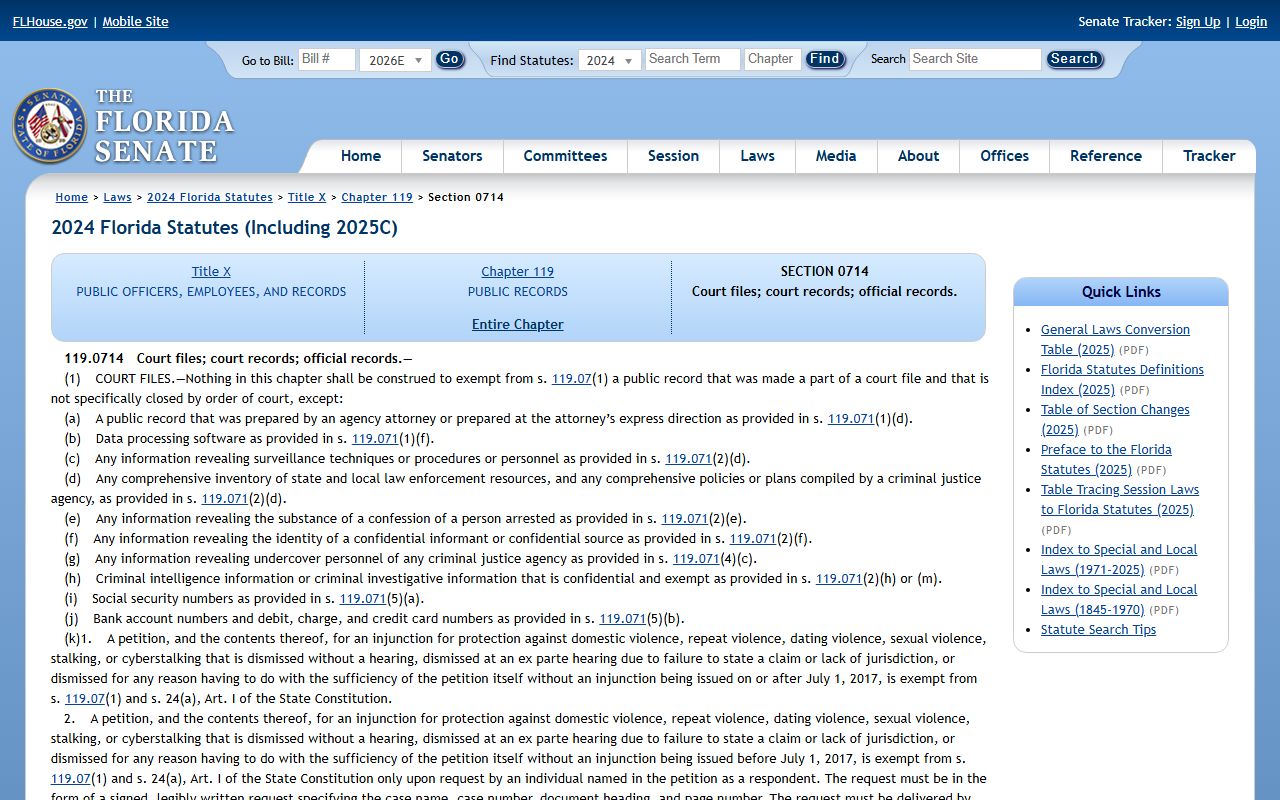
One key statute restricts what a clerk may display on a public website. The screenshot below shows the Florida Senate page for that statute.
The text of Florida Statutes 119.0714 sets the confidentiality and redaction rules for court files and official records. The image below shows that statute page.
A second statute limits the kinds of recorded images a clerk may post online. The Senate page below shows it.
Under Florida Statutes 28.2221, the Clerk may not display certain official-record images on a public website, including documents tied to probate, family law, military discharges, and death records. The screenshot below shows that statute.
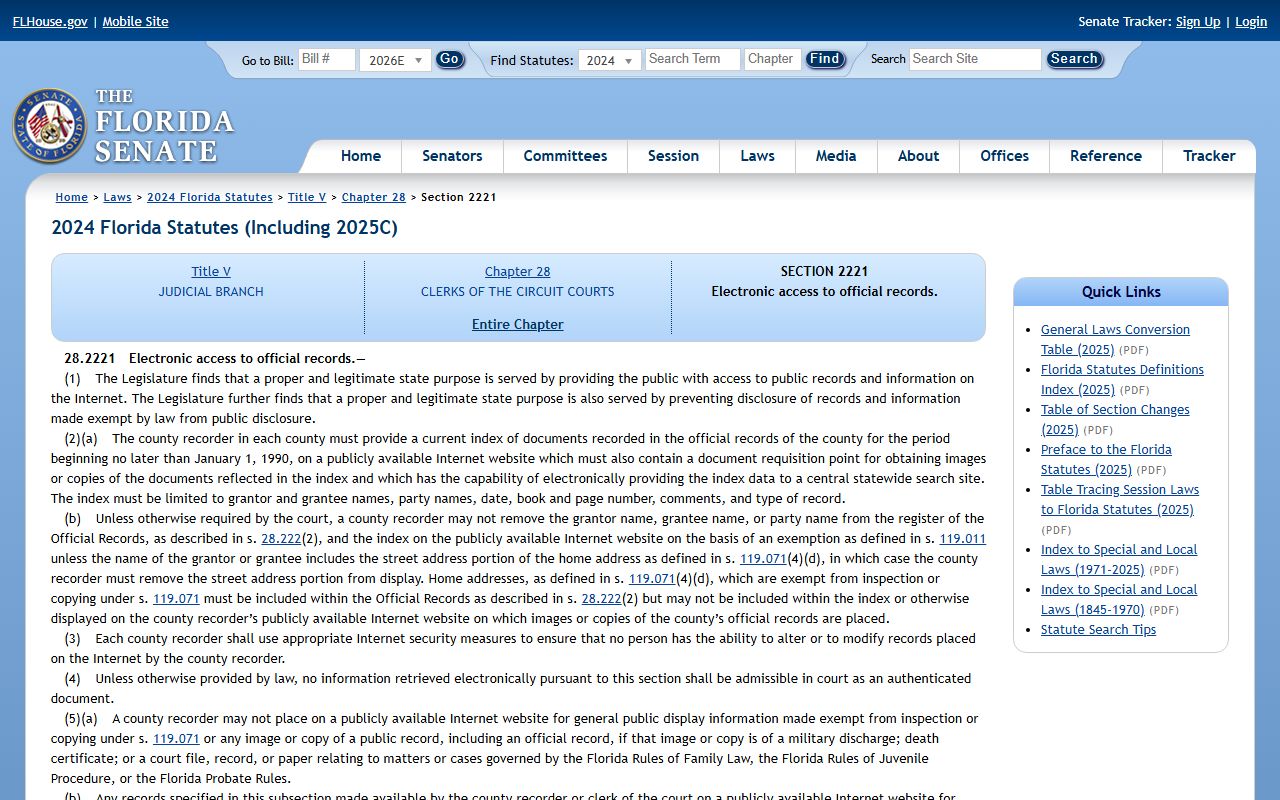
The Clerk's own redaction page cites 28.2221(5) and 119.071(5) when it explains protected personal data. The full open-records chapter sits at Chapter 119, Florida Statutes. For the court-records side, Rule 2.420 is the controlling judicial-branch rule. To file a written request for items not online, the Clerk's public records request page routes searchers to the Public Records Liaison.
Note: Rule 2.420 and AOSC 15-18 can limit online public display even when the same record may still be viewed in person or ordered by copy request.
Records That Are Sealed or Confidential in Pasco County
Not every Pasco court file is open to the general public. Juvenile delinquency and dependency files are limited under Florida Statutes 985.04 and 39.0132. Adoption files are confidential under 63.162. Mental health clinical files fall under 394.4615. Social security numbers, bank numbers, and card numbers are stripped from public copies under 119.071. Sealed and expunged criminal files are governed by 943.0585 and 943.059.
Sealing and expunction in Florida start at the state level, not the courthouse counter. A person must first apply to FDLE for a Certificate of Eligibility. The FDLE seal and expunge FAQ explains that step. After FDLE issues the certificate, the applicant files a petition, an affidavit, the certificate, and a proposed order in the court that handled the case, then serves the State Attorney. The Clerk cannot unseal a record on its own. That order has to come from a judge.
Official Records vs Pasco County Court Records
Official Records are not the same thing as court case files. They are the recorded-document index the Clerk keeps as county recorder, and they include deeds, mortgages, liens, plats, satisfactions, and many court documents such as final judgments. The Clerk's Search Official Records page says the index is searchable by name within document types and by date range, with book/page and instrument numbers giving direct access to a single document.
Coverage and display differ from OCRS. Indexes run from 1975 to the current date. Images run from 1990 to the present, but probate and family-law images, military discharges, and death certificates are not viewable online. The fields used to search Official Records are listed below.
| Field Label | Type | Required | Notes / Format |
|---|---|---|---|
| Name | Text | No | Search by names in the Official Records index. |
| Document Type | Dropdown | No | Narrow the search within a document category. |
| Date Range | Date range | No | Search within a span of dates. |
| Book and Page | Text | No | Direct access to one recorded document. |
| Instrument Number | Text | No | Direct access by recording number. |
Certified Copies and In-Person Pasco County Court Records
An OCRS printout is not a certified record. For an authoritative copy that a bank, employer, agency, or court will accept, you need a certified copy from the Clerk. The Official Records fee chart sets the cost: $1 per page for copies, $2 per document for certification, and $2 per search for a computer record search where available. A 3.5 percent card fee is added on debit or credit transactions, and that fee is charged by MyFloridaCounty, not the Clerk.
You can order in person, by mail, or by phone. The Clerk's Official Records fees and costs page lists the charges and payment methods. East Pasco court files and copies route through the Dade City office below. Hours are Monday through Friday, 8:30 a.m. to 5:00 p.m. Bring the case number or party name to speed up the request.
Pasco Clerk and Comptroller, Court Records
Robert D. Sumner Judicial Center
38053 Live Oak Avenue
Dade City, FL 33523
(352) 521-4489
Mon-Fri 8:30 a.m. to 5:00 p.m.
Note: A certified copy needs the whole document ordered, not a single page, and certification runs $2 per document on top of the $1 per-page copy fee.