
How to Look Up Pasco County Jail Population Data
Pasco County does not run a single population dashboard the way some big-city jails do. The closest live source is the public Pasco Corrections in-custody system, which lists each person held at the moment of the query. That system is built on a public API, and the in-custody endpoint returns a fresh JSON list of every current inmate. A count of that list gives a point-in-time roster number. It updates as the jail books and releases people, so it shifts through the day. It is not a certified figure.
Official jail population data, the kind reported on a fixed cadence, lives at the national level. The Bureau of Justice Statistics collects jail counts from across the country and publishes them on a set schedule, often once a year. The Bureau of Justice Statistics frames Pasco County jail population data within state and federal totals.
The BJS site holds the annual jail and prison series most analysts lean on. Reading these sources together is the trick. The live county roster tells you who is in custody today. The national reports tell you how a county jail compares over time and against the rest of the country. Neither number replaces the other.
Pasco County Jail Capacity Overview
Custody in Pasco County is centered on the main jail in Land O' Lakes. The county also runs a separate building used only for visits and family services. The official rated bed capacity for the main jail was not published in the public Corrections pages reviewed for this data. That is a real gap. So the table below lists each facility and marks capacity as not published rather than guessing at a number.
| Facility | Address | Rated Capacity | Current Count |
|---|---|---|---|
| Pasco County Jail / Pasco Corrections | 20101 Central Blvd, Land O' Lakes, FL 34637 | Not published | Live roster via public API |
| Resource and Visitation Building | 10326 Asbel Road, Land O' Lakes, FL 34637 | N/A (visit support) | N/A |
Because the rated bed count is not posted, no official crowding rate can be cited for Pasco. To gauge whether a jail runs over or under its beds, you need both the live count and the rated capacity. With one half missing, the safe move is to track the live roster trend and weigh it against the county population, which county pages list at 659,114.
Average Daily Population
Average daily population, or ADP, is the mean number of people held over a full reporting period. It smooths out the daily swings the live roster shows. A jail can book dozens of people on a busy weekend and release many by Monday, so any single snapshot can mislead. ADP fixes that by averaging across many days.
An official Pasco County ADP figure was not located in the public Corrections pages reviewed for this data, so no certified county ADP is stated here. What can be done is a careful point-in-time count from the live roster, clearly dated, treated as a snapshot and not an annual average. For a true ADP, the BJS jail series and county budget reports are the right sources, since those publish averaged figures rather than a single day's tally.
Pasco County Inmate Population Demographics
The public Pasco Corrections system does not post a tidy demographic chart. What it does expose, through its public API, is a set of per-inmate fields. Anyone counting the live roster can group these fields to build a point-in-time demographic snapshot. That snapshot is descriptive, not an official breakdown, and the values shift as people are booked and released.
The fields the public custody data exposes are listed below. Race and sex come back as one-letter codes in the raw data, and the booking date and time mark when each person entered custody.
| Field | What It Shows |
|---|---|
| Booking Date / Time | When the person entered custody (MM/DD/YYYY and HH:MM:SS). |
| Age | Numeric age of the person in custody. |
| Race | One-letter code in the raw data (for example W or B). |
| Sex | One-letter code in the raw data (M or F). |
| End of Sentence | A date, or "Currently Unavailable" where none is set. |
| Charges | Charge code, offense type, charge type, bond, and disposition. |
These six field groups are the raw material for any honest demographic read of the Pasco County inmate population. Group by age band, race code, or sex and you get a profile of the live roster. Group by charge type and you start to separate felony holds from misdemeanor holds. Just keep the limits in mind: it is a roster snapshot, dated, not a certified county statistic.
Pretrial vs. Sentenced Population
Jails hold two broad groups. One group waits for trial and has not been convicted. The other group serves a short sentence or waits for transfer to state prison. The split between them matters. A high pretrial share often points to bond and court-timing pressures rather than the volume of sentenced people.
Pasco does not publish a clean pretrial versus sentenced ratio. The live custody data hints at status through the end-of-sentence field and the charge disposition, but those signals are not a labeled status count. So the table below frames the split using national jail context rather than exact Pasco figures.
| Status | Pasco County | National Context (BJS) |
|---|---|---|
| Pretrial / unconvicted | Not published | Majority of local jail inmates nationally are held pretrial |
| Sentenced / convicted | Not published | A smaller share serve a sentence or await transfer |
The national pattern from BJS is that most people in local jails on any given day have not been convicted. Whether Pasco tracks that pattern cannot be confirmed from the public roster alone. The BJS jail series remains the source to cite for any firm pretrial share, and it should be read as national, not county-level, until Pasco posts its own count.
Misdemeanor vs. Felony Population
The public charge data does mark offense type. Each charge in the custody system carries an offense type value, and the values seen include FELONY and MISDEMEANOR. That means a careful read of the live roster can split current charges into the two buckets, charge by charge.
One caution holds here. A single person can carry several charges at once, and those charges can mix felony and misdemeanor levels. So a charge-level split is not the same as a head count of people. Court case numbers in the charge data also embed a court type code, with felony cases and misdemeanor cases using different markers. To read the underlying charges and arrest detail behind those codes, see Pasco County arrest records. No fixed felony-to-misdemeanor percentage is published for Pasco, so any ratio drawn from the roster is a dated snapshot, not a certified figure.
Mental Health and Medical Population
Jails carry a real medical and mental health load. Nationally, a large share of jail inmates report a mental health condition or a chronic medical need, and research groups track this closely. The county jail is the point where many people first meet treatment, screening, and medication needs.
Pasco's public custody system does not flag medical status, mental health holds, suicide watch, or protective custody. Those fields are kept off the public profile, which is normal practice for health privacy. So no Pasco-specific medical or mental health population share can be stated from the public data. For the broader picture, the Prison Policy Initiative compiles research on health needs across jails and prisons.
The Prison Policy Initiative pulls together studies that show how often jails serve as default care settings.

Read that work as national context, not a Pasco count. It frames the scale of the issue and the cost pressure it puts on county jails, which helps when reading any local budget line for jail health services.
National and State Context for Pasco County Data
Raw counts mean little without a yardstick. The standard yardstick for jail data is the rate per 100,000 residents. That rate lets a small county and a big state sit on the same scale. BJS publishes the national jail incarceration rate, and the Vera Institute tracks county-level rates over time, which is the level closest to Pasco.
Because Pasco does not post its own certified rate, the comparison block below is framed as context. The Pasco row is marked as a roster-based estimate that depends on a dated live count, while the state and national rows point to the bodies that publish those figures. None of these should be read as an exact, official Pasco rate.
| Level | Jail Rate per 100,000 | Source / Status |
|---|---|---|
| Pasco County | Estimate only, from dated live roster count | Not officially published; derive from API count and 659,114 population |
| Florida | See state jail series | BJS and Vera Institute state-level data |
| National | See BJS annual jail report | Bureau of Justice Statistics |
The Vera Institute incarceration trends tool is the cleanest way to place Pasco against other Florida counties and the national line. Pair it with the BJS annual jail report for the firm national rate. Read together, they show whether a county leans high or low without forcing a number the county itself has not certified.
Note: Rates per 100,000 let you compare a 659,114-resident county like Pasco against a whole state on equal footing.
Pasco County Jail Population Trends Over Time
A trend line needs many dated points, not one snapshot. No official Pasco Corrections five-year ADP or capacity trend report was found in the public pages reviewed for this data. So a true multi-year Pasco curve cannot be drawn from county sources alone.
Two paths fill that gap. First, the public in-custody API can be queried on a regular schedule, with each count dated, to build a homegrown trend over weeks or months. Second, the Vera Institute incarceration trends tool already holds year-over-year county jail figures pulled from federal collections, which gives a longer historical view than any single roster query. County budget and annual report PDFs can add staffing and jail-cost lines that often move with population. Used together, these let you sketch a Pasco trend honestly, with each figure tied to its source and date.
Searching for Pasco County Inmate Records by Name
This page covers aggregate jail population data, not individual lookups. For a name-based search of the live jail roster, with booking details and charges for a specific person, use the Pasco County inmate records page. To trace someone after release, see released inmates.
Where the Pasco County Population Data Comes From
The county-specific numbers all trace back to one public system: the Pasco Corrections in-custody application and its API. The in-custody endpoint at the public in-custody API returns the live list used for any point-in-time count.
The screenshot of that in-custody endpoint shows the raw JSON the public count is built from.
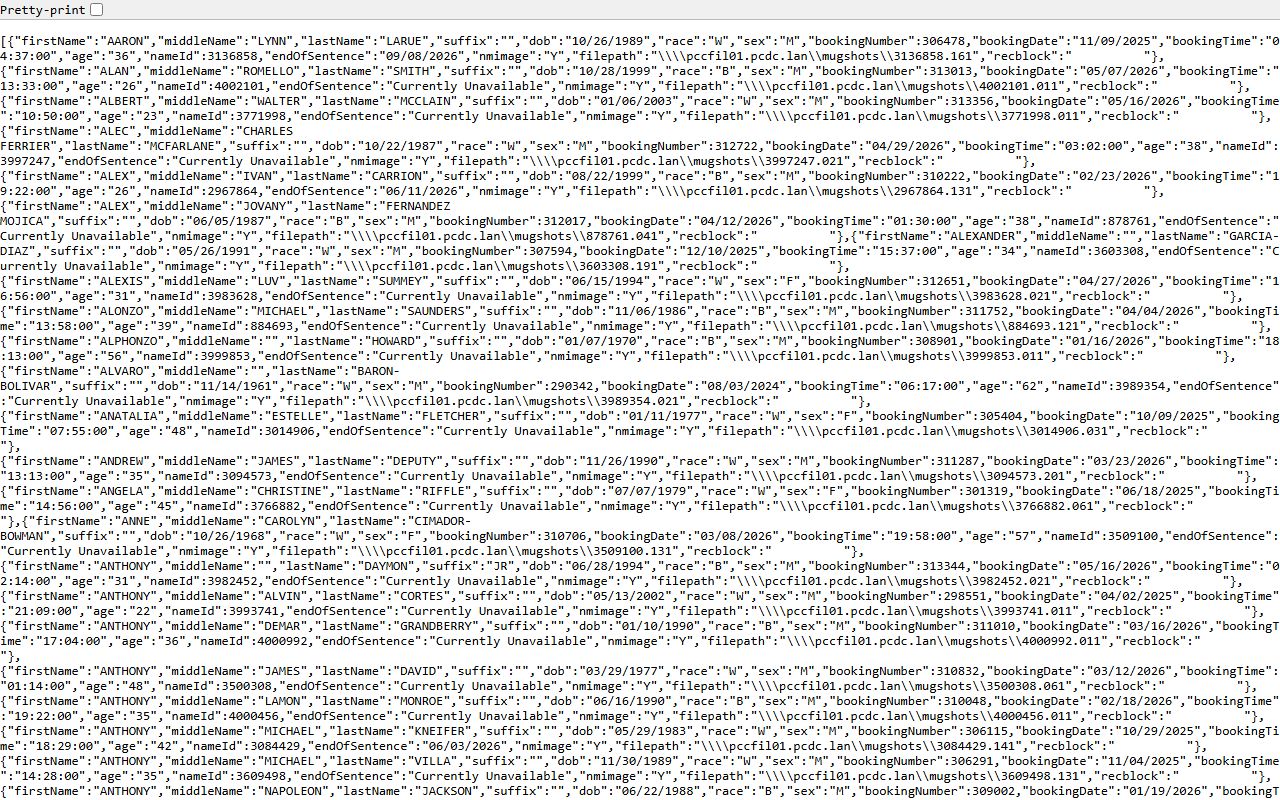
Name and field filtering run through a second endpoint. The custody search API accepts a name filter and powers the public search route.
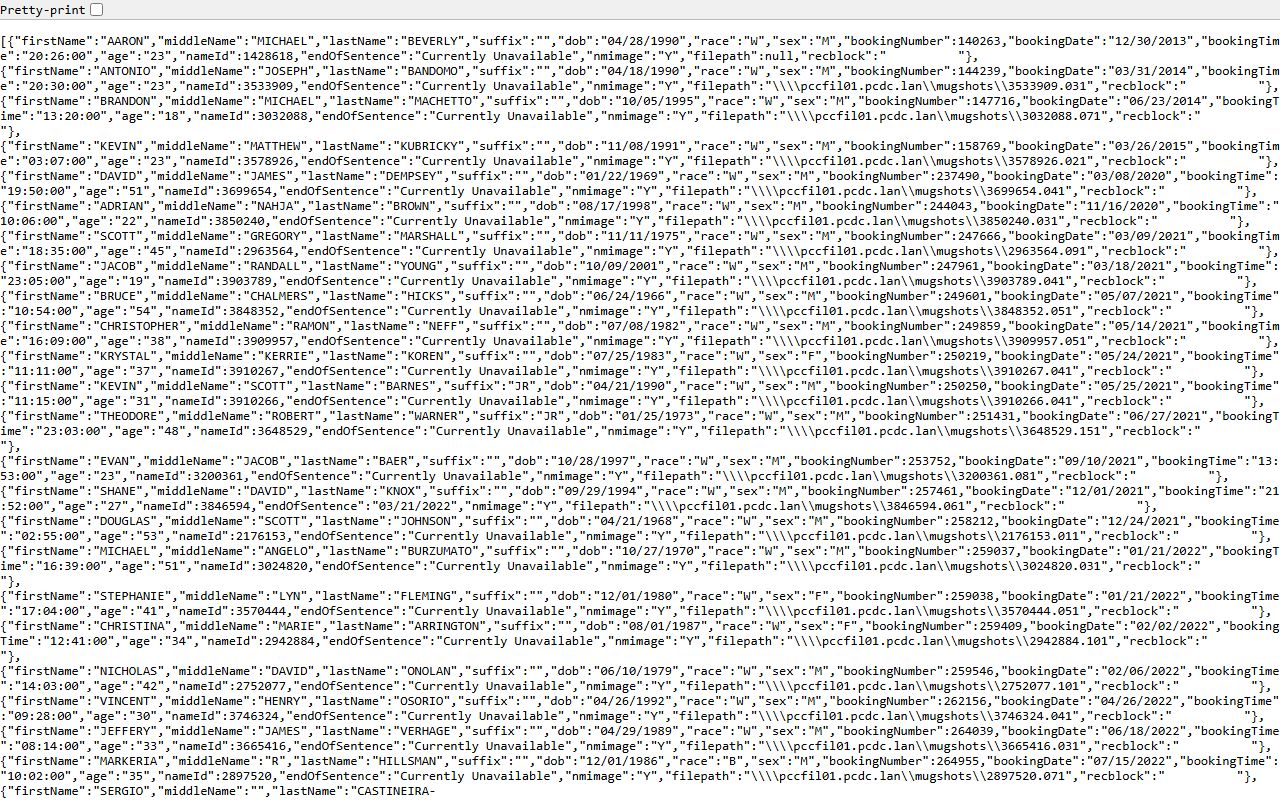
Past and released records sit on a separate path. The inactive custody API is what lets the system surface historical custody data, which matters for any trend built over time.
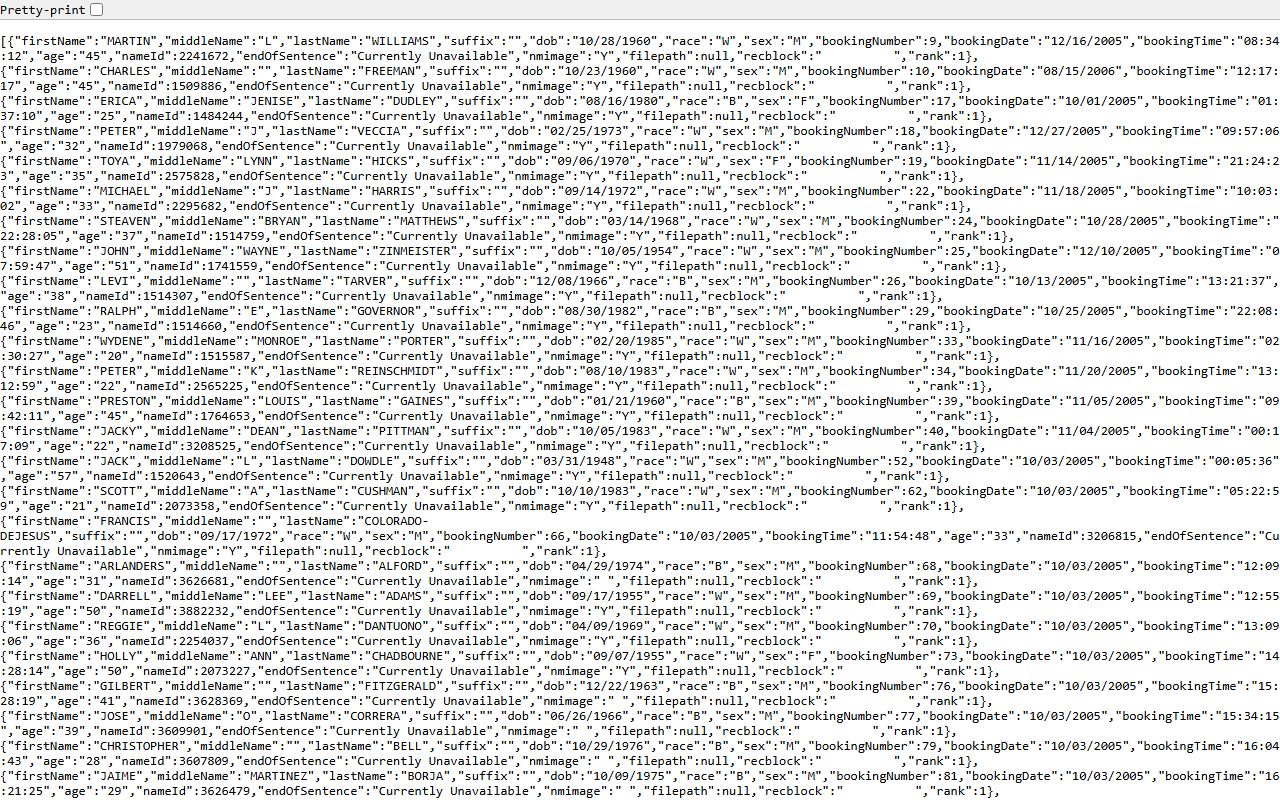
The state and national context, every figure marked as context above, comes from research bodies, not the county. The Bureau of Justice Statistics supplies the national jail series, the Vera Institute incarceration trends tool supplies county-level rates, and the Prison Policy Initiative supplies the health and pretrial research. Keeping the county roster and these national sources clearly apart is the whole point. Live count is local. Rates and trends are context.