
Florida Public Records Law in Pasco County
Florida has one of the broadest open-records traditions in the country. The right starts in the state constitution. Article I, section 24 grants the public access to records made or received by state and local agencies. The legislature carries that right out through Chapter 119, Florida Statutes, the Public Records Law. Chapter 119 sets the duty to inspect and copy, the fee framework, and the list of exemptions. The Pasco County Clerk cites Chapter 119 directly and says most records in Clerk custody are open for public inspection.
Any person can ask for a public record. You do not have to be a Florida resident, a party to a case, or an attorney. You do not have to explain why you want it. The law treats a request from a curious neighbor the same as one from a reporter or a lawyer. A public record is broad too. It covers documents, maps, recordings, and data made or received in connection with official business. The Clerk's office must respond in good faith and within a reasonable time.
Court records carry an extra layer. They also follow Florida Rule of General Practice and Judicial Administration 2.420. Rule 2.420 defines judicial branch records and lists confidential categories. So the Clerk must balance the open-records right with automatic confidentiality, redaction, online display limits, and any sealing or expunction order tied to a case.
What the Pasco County Clerk Holds
The Clerk of the Circuit Court and Comptroller is the main keeper of public records in the county. The office files and stores court cases. It also serves as the county recorder. That recorder role pulls in a large body of records that have nothing to do with a lawsuit. Under Florida Statutes 28.222, the Clerk records documents that relate to interests in real and personal property. The result is a deep index of recorded papers searchable by the public.
Beyond court files, the Clerk's recorded official records include a wide mix of legal instruments. The online searchable categories the Clerk lists are a good guide to what you can find.
- Deeds and mortgages
- Liens and lis pendens notices
- Final judgments and court orders
- Satisfactions and assignments
- Plats and dismissals
Note: a single civil judgment can sit in two systems at once, both as a case docket in the court search and as a recorded final judgment in the official records index.
Official Records vs Court Records in Pasco County
Pasco County runs two separate online access points, and they are not the same thing. Knowing which one to use saves time. The court case search is the Online Court Records Search, hosted for the county on the Civitek platform. It exposes case lookups by party name and by case number and is governed by court access rules. The official records index is the county recorder system. It holds recorded property and legal instruments.
The two worlds overlap at recorded court documents. A lien-related document or a final judgment can appear in both places. But a deed or a mortgage lives only in official records, and a live case docket lives in the court search. For court files, see the dedicated court records page. For the office that keeps both systems, see the Clerk of the Circuit Court and Comptroller page.
The official records index has strong time coverage. The Clerk's Official Records division page describes recording, search tools, tax deed sales, and property fraud alerts handled by the office. The image below shows that division page.
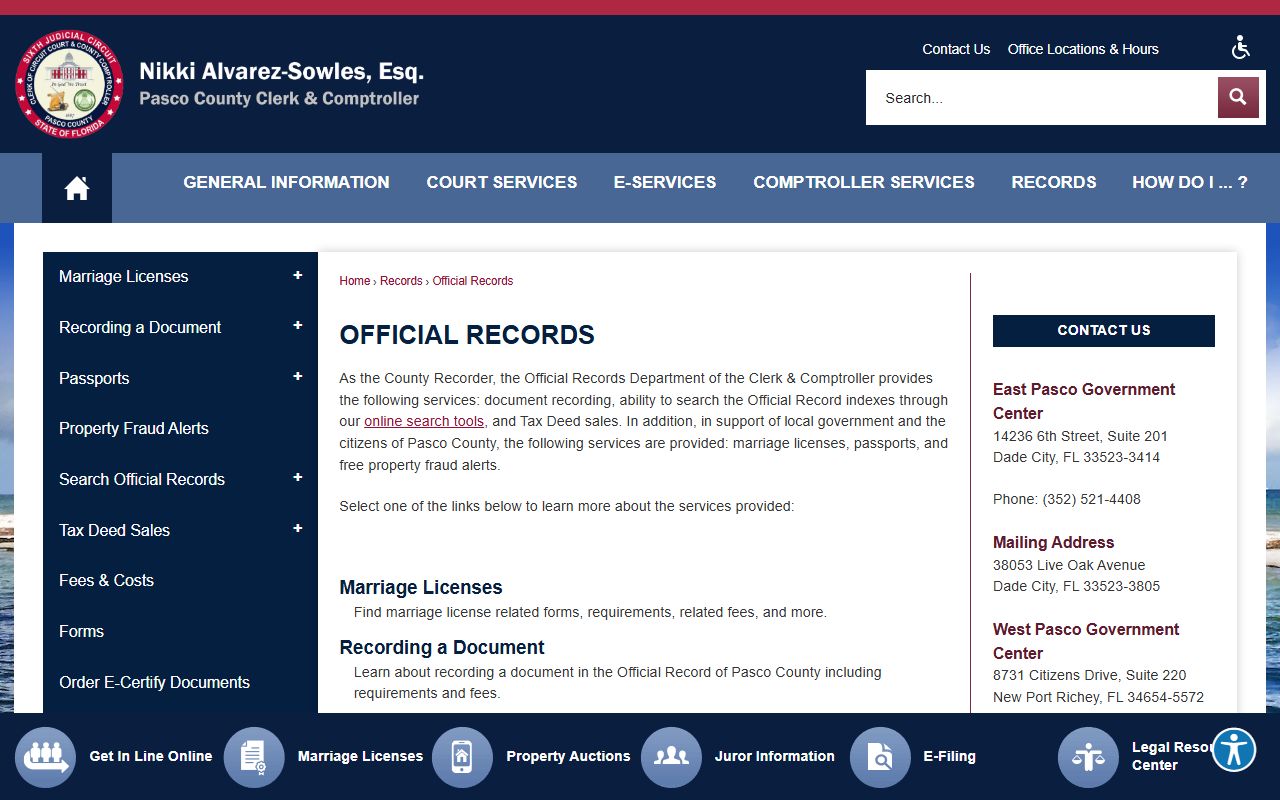
The division page is the front door for recorder services, while the search page is where you actually run a name or instrument lookup.
Searching Pasco County Official Records Online
The Clerk's Official Records search page lets the public look up records by name within document types and date ranges. You can also jump straight to a single document using its book and page or its instrument number. The indexes run from 1975 through the current date. Images run from 1990 to present, with some types held back from online view. The screenshot below shows that search landing page.
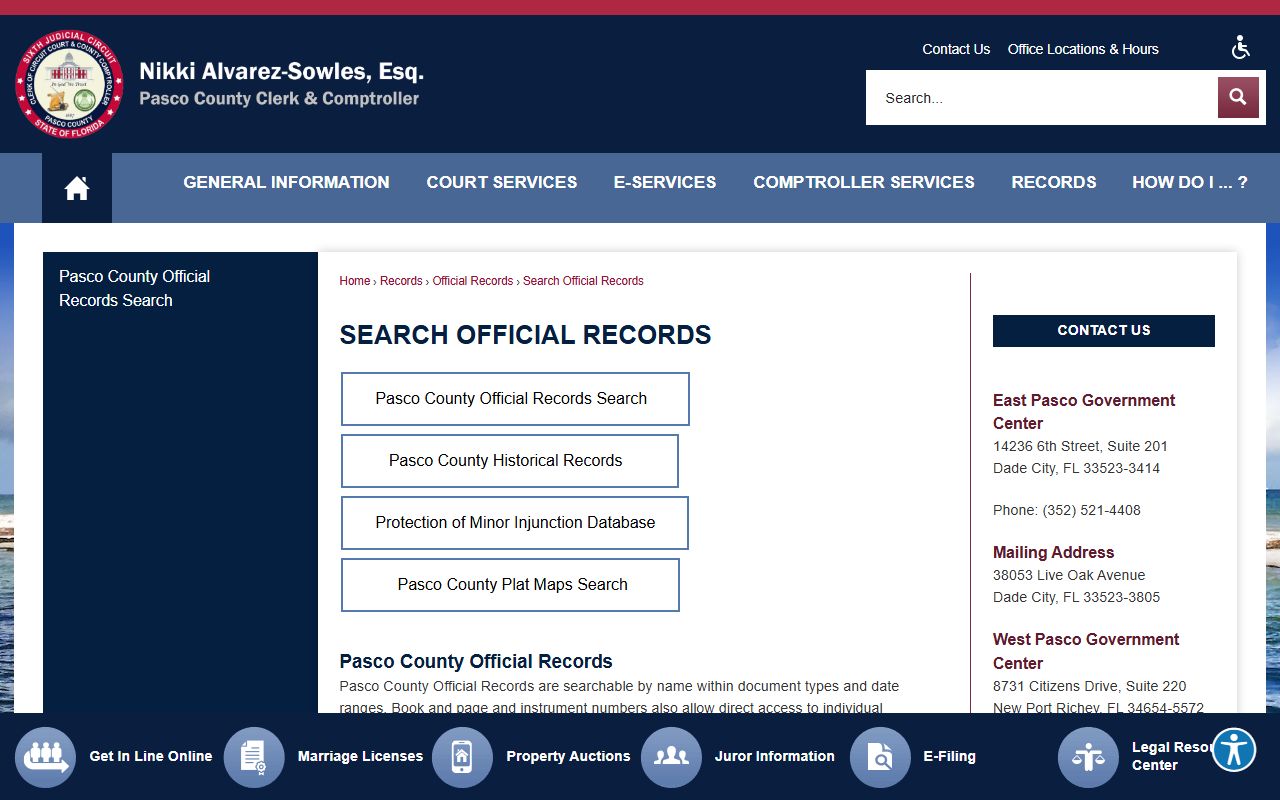
From this page you can also reach the historic records, the injunction database, and the plats. The main search fields are simple, and you only need one good locator to find a document.
| Field | Type | Notes |
|---|---|---|
| Name | text | Search by names in the official records index. |
| Document Type | filter | Narrows results to a record category. |
| Date Range | date range | Limits the search to a span of dates. |
| Book and Page | text | Direct access to one document. |
| Instrument Number | text | Direct access to one document. |
Why can you find an index entry but not the image? Some categories stay off the public website even when they are indexed. Images for documents tied to probate or family law cases are not viewable online. Neither are military discharges or death certificates. So you may see that a record exists, then need a copy request to get the actual document.
How to File a Pasco County Public Records Request
The Clerk's public-records process follows a simple path. Search online first. If the record you want is not searchable online, contact the Public Records Liaison. The office asks you to describe the records clearly so staff can find them. You do not have to use a special form to ask, though copies of official documents have their own order form.
- Search online first. Use the official records index for recorded documents or the court case search for case files.
- If the record is not online, identify the right office. Most files run through the Clerk of the Circuit Court and Comptroller.
- Describe the records you want. Give names, dates, a case or instrument number, or a document type so staff can locate the file.
- Contact the Public Records Liaison by email at publicrecordsrequest@pascoclerk.com, or by phone at (352) 523-2411 or (727) 847-2411 and ask for the Clerk & Comptroller's Public Records Liaison.
- To mail a request, write to the Public Records Liaison, P.O. Box 338, New Port Richey, FL 34654-0338.
- Wait for the response, then pay any copy or certification fees and receive the records.
The Clerk's public records request page lays out this same path. The official wording is that many public records are available online and many of those documents may be viewed and printed. That phrasing leaves room for non-searchable records and restricted images.
Public Records Request Details to Include
A clear request gets a faster answer. Staff cannot read your mind, and a vague ask slows everything down. When you reach the liaison, include the basics below. For copies of recorded documents, the Official Records Document Order Form asks for the same kind of locators.
| Field | Required | Notes |
|---|---|---|
| Requester Name | Yes | Needed so the office can reach you with the records. |
| Description of Records | Yes | Names, document type, or a case or instrument number. |
| Date Range | No | Helps narrow a large index search. |
| Format Preference | No | State whether you want plain or certified copies. |
| Contact Information | Yes | Mailing address or email for the return of records. |
The Document Order Form itself asks for the instrument number, the book and page, the pages to copy, and whether you want a certified copy. To get a certified copy, the whole document must be ordered, not just one page.
Response Timelines and Denials
Florida law does not set a fixed number of days for a response. Instead, Chapter 119 requires a good-faith response within a reasonable time. What counts as reasonable depends on the size and complexity of the request. A short, well-described ask should move fast. A broad request that spans many years or needs heavy review may take longer.
If a record is withheld, the office should point to the exemption that applies. A denial without a cited reason is a problem. You can seek review through the courts and may consult the Florida Attorney General's open-government guidance. The Clerk's public-records page does not publish an internal appeal form, so a court action is the formal route if a dispute cannot be worked out with the office.
Pasco County Public Records Fees
Searching the online index is generally free, but copies and certifications carry fees. Chapter 119 governs public-records fees in general, including actual costs where the law allows. The Clerk's Official Records fees page lists the standard charges, shown below. The screenshot shows that fee schedule.
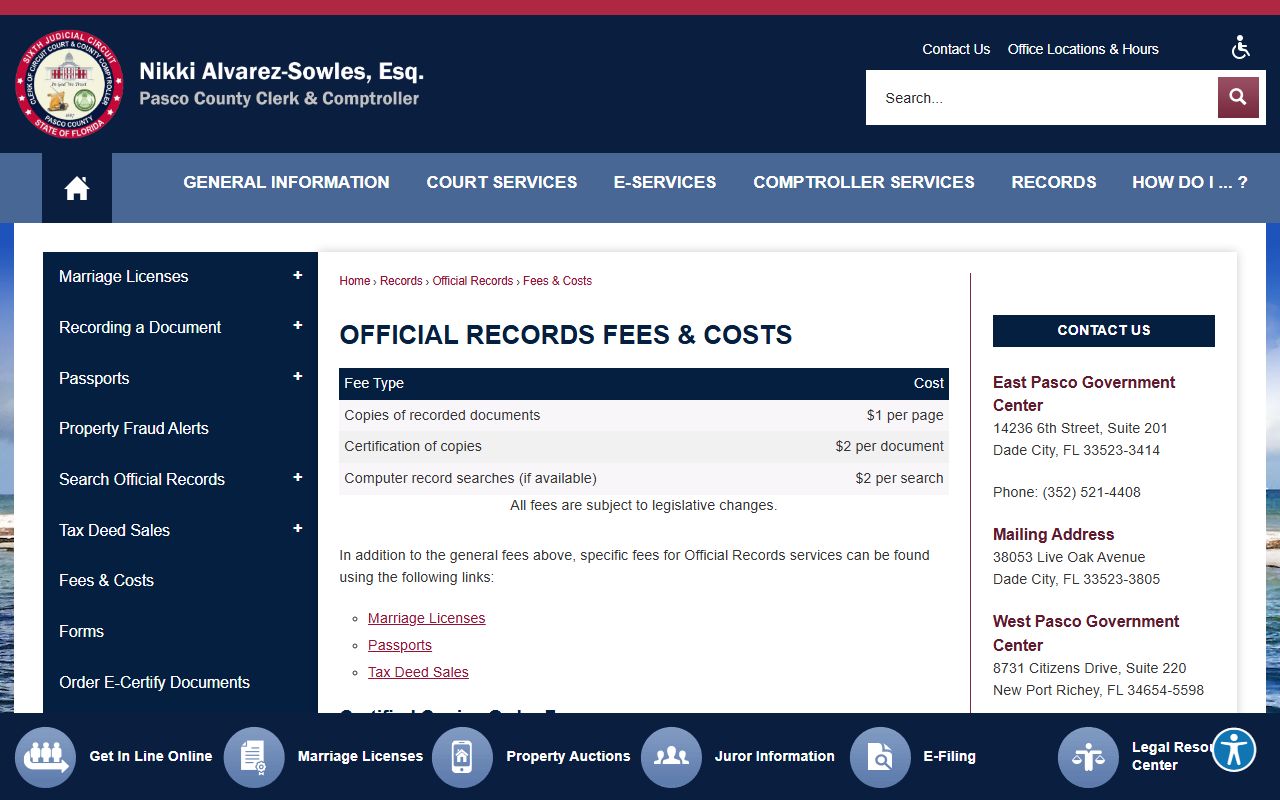
The page also confirms how to buy a certified copy by phone using a card. Note the small card fee added to electronic payments.
| Item | Amount |
|---|---|
| Copies of recorded documents | $1 per page |
| Certification of a copy | $2 per document |
| Computer record search, if available | $2 per search |
| Credit or debit card fee | 3.5% |
Payment methods are broad. The office takes cash, bank check, business check, money order, and major cards including American Express, Discover, MasterCard, and Visa. A personal in-state check works with proper ID. Do not mail cash. Checks and money orders are payable to Nikki Alvarez-Sowles, Clerk & Comptroller. You can buy certified copies by phone at (352) 521-4408 or (727) 847-8086.
Records That Are Closed or Redacted
Not every record is open. Florida law carves out exemptions, and the Clerk must apply them. Some files are fully confidential. Others are open but with certain data redacted. The Clerk's protecting official records page explains the redaction rules and cites the governing statutes. The image below shows that page.
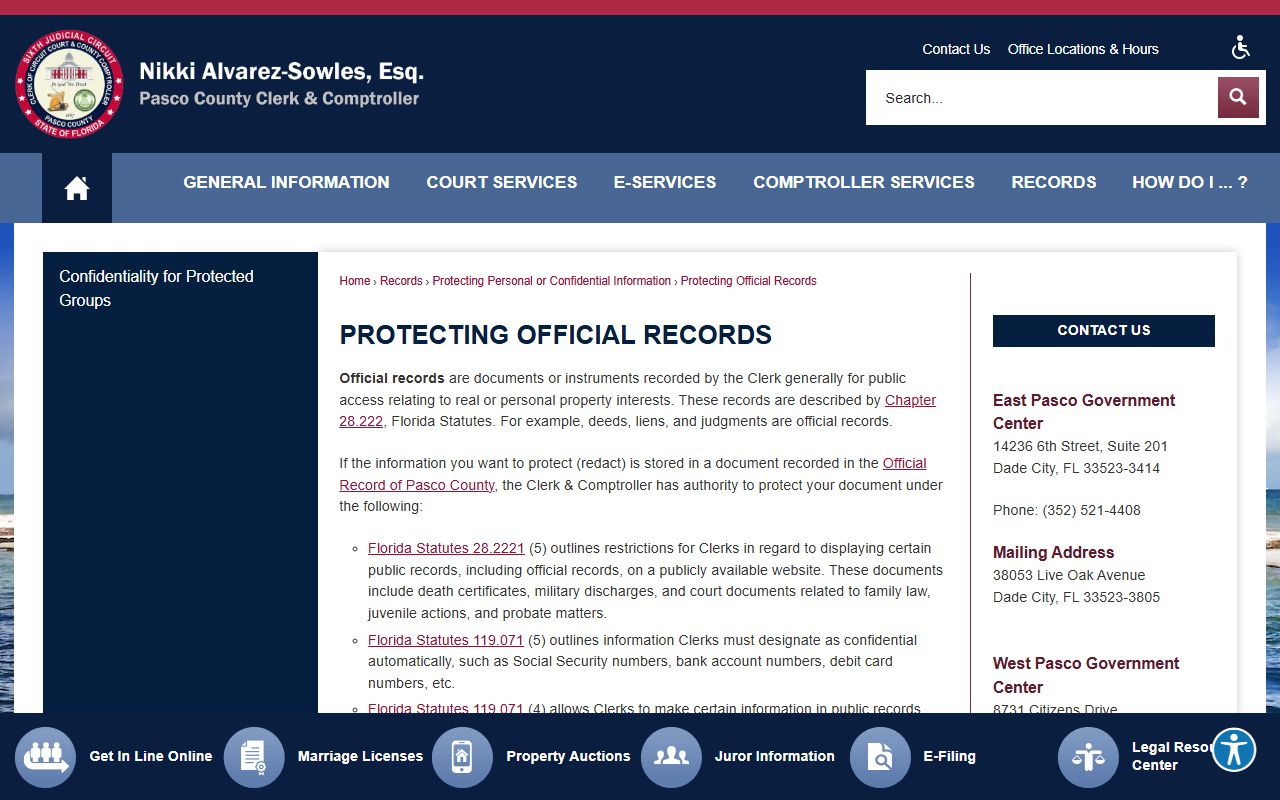
Two statutes drive the redaction work. Florida Statutes 119.071(5) protects items like Social Security numbers and bank, debit, and credit card numbers. Florida Statutes 28.2221(5) limits the public web display of certain record images. That second statute is why probate and family law images, military discharges, and death certificates stay off the online official records system.
Other categories are closed under their own laws.
- Juvenile justice records under Florida Statutes 985.04
- Dependency and child welfare records under Florida Statutes 39.0132
- Adoption records under Florida Statutes 63.162
- Mental health clinical records under Florida Statutes 394.4615
- Sealed or expunged criminal records under Florida Statutes 943.0585 and 943.059
Requesting Redaction of Personal Information
You can ask the Clerk to remove protected personal information from records that are online or in the index. This is different from sealing a case. Redaction takes out specific data points and leaves the rest of the record open. The authority comes from Florida Statutes 119.0714 for court files and official records, along with the protections in 28.2221(5) and 119.071(5).
Certain people get added protection. Qualifying professions, their spouses, and their children may request that home addresses and other contact details be held from public view. The Clerk's protecting official records page is the place to start a redaction request and to learn what data the office can remove.
Court Records and Rule 2.420
Court records sit under both the open-records right and the judicial branch's own rule. Rule 2.420 is the controlling rule for public access to judicial branch records. It defines court records, sets confidential categories, and lays out how a party asks the court to seal or hold information as confidential. The administrative order known as AOSC 15-18 also limits how much case detail shows online, even when the record can be inspected in person or by copy.
So online court access can look thinner than the full file. That gap is by design. For deeper case material, you may need to view files at a records facility or order copies. For family files, see marriage and divorce records. For estate files, see probate records. More common questions are answered on the FAQ page.