
Arrest Records in Pasco County
An arrest record is created the moment a person is booked into the county jail. Pasco County arrest records are generated by Pasco Corrections under Pasco County Government, working with the Pasco Sheriff's Office and other agencies that bring people in. The jail logs the arrest, takes a booking photo, and opens a profile that lists the charges, the bond, the arrest agency, and the booking date. That profile is the raw front end of a criminal case. It shows what a person was accused of and held on, before any judge has ruled on the facts.
Arrest data and full criminal court files are not the same thing. The arrest record lives with the jail. The criminal court record lives with the Clerk of the Circuit Court and Comptroller and tracks what the court did with each charge over time. Pasco felony cases use the CF code, misdemeanors use MM, and criminal traffic offenses such as a charged DUI use the CT code. For the full case docket, pleas, motions, and final disposition, see the Pasco County court records page. This page stays focused on the arrest side and the criminal history that follows it.
Most arrest data in Florida is public. The state has one of the broadest open-records traditions in the country. Still, some criminal records are sealed, expunged, or held back when a person is a minor or when a case stays under investigation.
How to Search Pasco County Arrest Records
The fastest way to find a recent Pasco arrest is the public Pasco Corrections inmate web application. It pulls current bookings and past arrests from the jail database. The app runs on a set of public API endpoints that return booking and charge data by name. You can review the Pasco Corrections arrest search service that powers the past-arrest lookup behind the app.
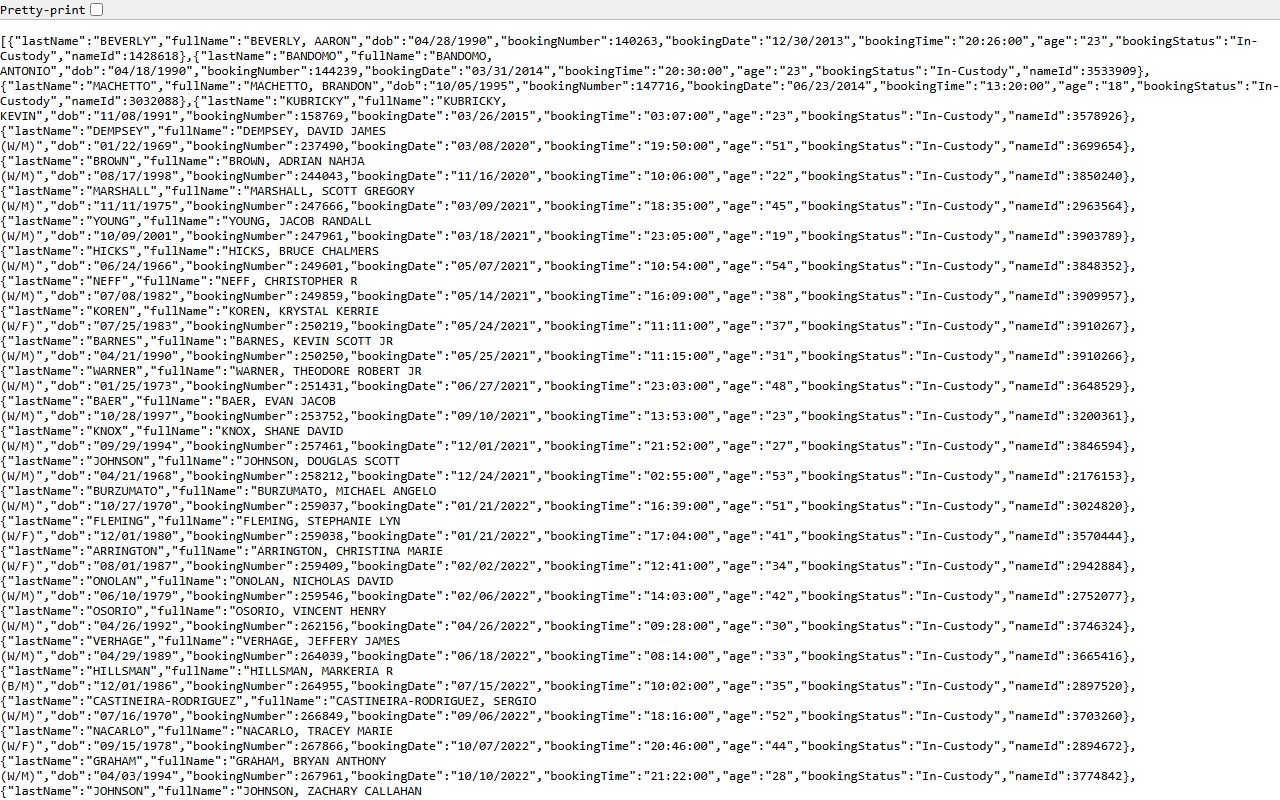
That endpoint accepts a name and returns matching past arrests, the same way the in-custody search returns current inmates. To run a search, start with the public app and work through these steps.
- Open the Pasco Corrections inmate app and choose the In Custody view for current bookings or the Releases view for past arrests.
- Enter at least a last name. Add a first name to cut down a long result list.
- Open a matching name to load the booking profile, the mugshot, and the charge table.
- Read the charge rows for the statute code, the bond, the docket number, the offense type, and the disposition.
For the court side of an arrest, search the same person in the Pasco OCRS court case system to see how the charges moved through the docket. The jail roster shows the booking; the court search shows the outcome. Both are free.
Arrest Records vs. Criminal Court Records
An arrest happens first. The jail books the person, sets or notes the bond, and lists the charges as the arresting agency wrote them. The criminal court record opens later, when the State Attorney files a charging document. From that point the case belongs to the court, and the docket starts to fill with motions, hearings, orders, and a final disposition. One person can have an arrest with no court conviction at the end. The two records answer different questions.
| Arrest Record | Criminal Court Record | |
|---|---|---|
| Source | Pasco Corrections and arresting agency | Clerk of the Circuit Court and Comptroller |
| Created When | At booking | When charges are filed |
| Contents | Booking data, charges, bond, mugshot | Pleadings, motions, hearings, disposition |
| Where to Search | Pasco Corrections inmate app | Pasco OCRS court case search |
Note: a charge listed on a jail booking can still be dropped, reduced, or dismissed once the State Attorney and the court review the case.
Charges vs. Convictions in Pasco County
People often read an arrest charge as proof of guilt. It is not. A charge is an accusation. It only needs probable cause, the low bar an officer or prosecutor must clear to bring a case. A conviction is a finding of guilt by plea or by trial, and it needs proof beyond a reasonable doubt. Both the charge and the conviction can show up in Pasco public records, so the reader has to know which one is which.
| Charge | Conviction | |
|---|---|---|
| Stage | Accusation at or after arrest | Verdict or plea |
| Burden of Proof | Probable cause | Beyond a reasonable doubt |
| Decided By | Officer or State Attorney | Judge or jury |
| Public Record | Yes | Yes |
Florida adds a third outcome that confuses many readers: adjudication withheld. Here the judge finds the facts but holds back the formal conviction, often pairing it with probation. It is not a clean acquittal and it is not a full conviction. A withheld adjudication can also affect whether a person can later seal or expunge the record. The State Attorney for the Sixth Judicial Circuit decides which charges to file, and the State Attorney Sixth Judicial Circuit office prosecutes Pasco cases. Eligible people who cannot afford a lawyer are defended by the Public Defender Sixth Judicial Circuit.
Charge Data in Pasco County Arrest Records
When you open a booking profile in the Pasco Corrections app, the charge table is where the real detail sits. Each charge gets its own row. The app pulls these rows from a dedicated charge service. You can see the Pasco Corrections arrest charge service that returns the per-charge data shown in the profile.
That charge service returns the fields below for each count. The bond and disposition fields are the ones people check most, since they show how a charge was handled and whether release was possible.
| Charge Field | What It Shows |
|---|---|
| Charge Sequence | Order number for each separate charge on the arrest. |
| Statute / Charge Code | Florida statute or charge code for the offense. |
| Bond Amount | Dollar amount or condition set for release on that charge. |
| Docket Number | Court case number, often in a YYYYCF or YYYYMM format with the court type built in. |
| Offense Type | Felony or misdemeanor level for the charge. |
| Disposition | Current result or holding status for the charge. |
The deeper booking detail comes from a second service. The Pasco Corrections arrest details service returns the facility, the arrest date, physical descriptors, and any release fields tied to the same booking.
Read the details and the charge rows together. The details give the who and when of the booking; the charge rows give the what and how much of each count.
Mugshots and Booking Photos
A mugshot is taken at booking and stored with the jail profile. In the Pasco Corrections app, a booking flags whether an image is on file, and the app pulls the photo by the internal name ID. When a photo exists, it shows on the public profile next to the name, date of birth, and booking data. Booking photos are public records in Florida, the same as the rest of the arrest data.
That said, a mugshot only proves an arrest, not a result. Use it to confirm identity, not to judge guilt. For the legal outcome, match the booking to the court docket through the Pasco court records search and read the disposition on each charge.
Sealed vs. Expunged Records in Pasco County
Florida law gives some people a path to limit or remove a criminal record. Sealing hides a record from general public view while a few agencies keep access. Expunction goes further: the record is destroyed or held by FDLE only, and in most settings the person can lawfully deny it ever happened. Sealing is set out in Florida Statutes 943.059. Expunction is set out in Florida Statutes 943.0585. The two have different eligibility rules, and a person usually cannot have a prior disqualifying conviction or a past seal or expunge to qualify.
| Sealed | Expunged | |
|---|---|---|
| Statute | 943.059 | 943.0585 |
| Visibility | Hidden from public view | Destroyed or treated as never existing |
| Law Enforcement | Limited access kept | Held by FDLE only, very limited |
| Typical Use | Often when adjudication was withheld | Often when charges were dropped or dismissed |
The screenshot below shows the official Florida statute text for expunction. The Florida Statutes 943.0585 page is the source for the court-ordered expunction rules.
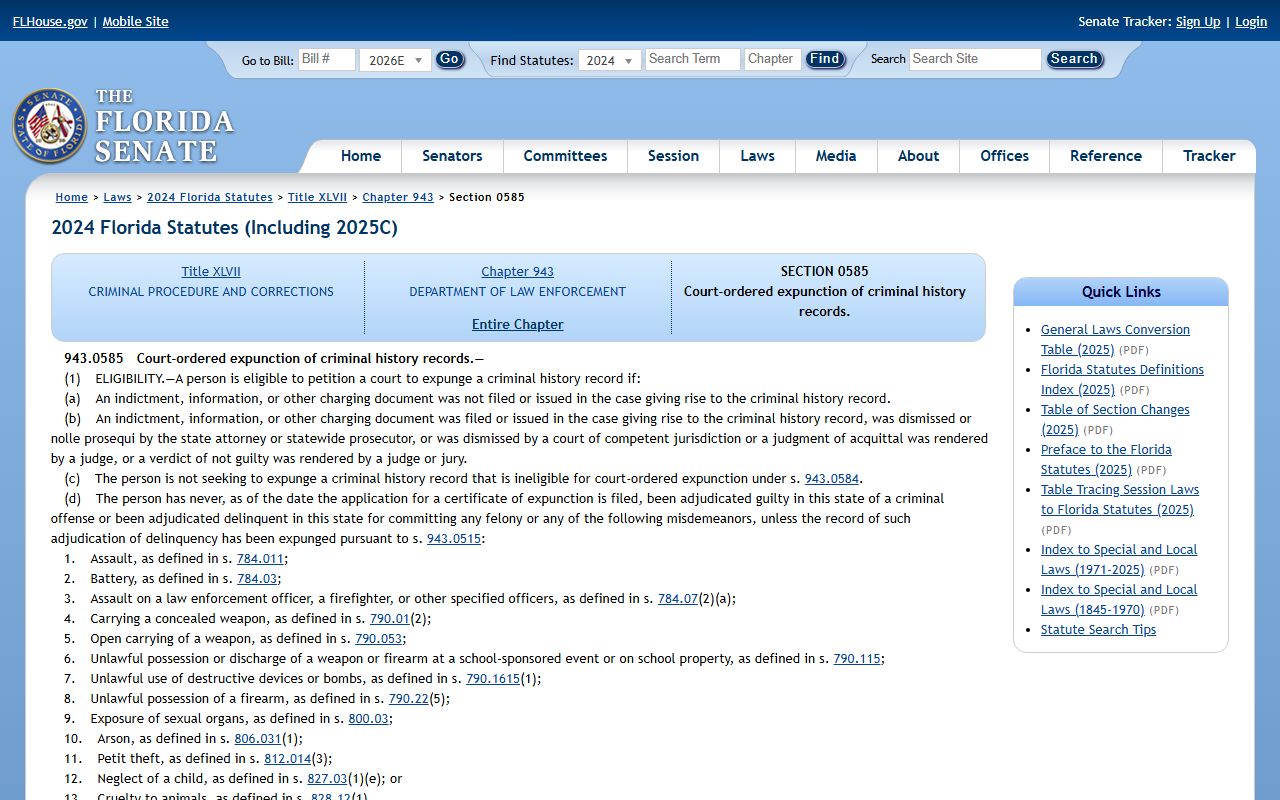
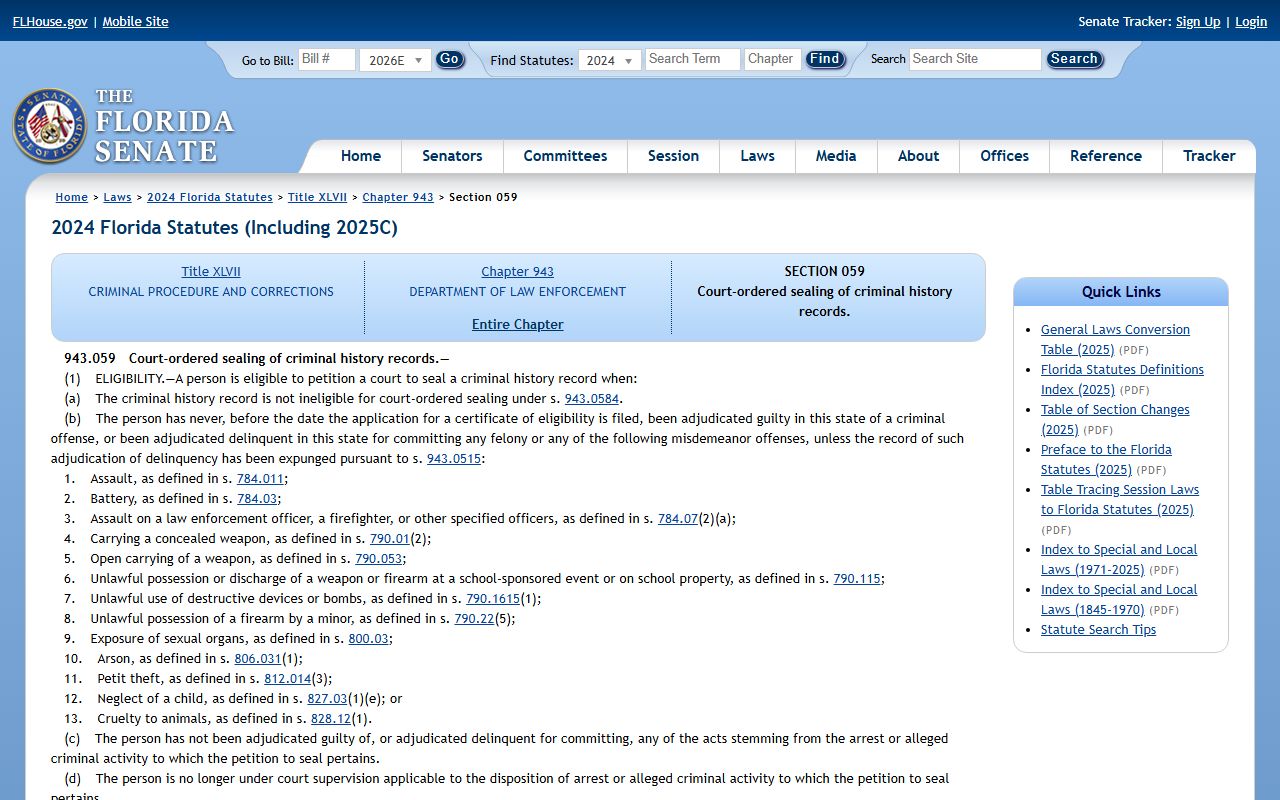
The matching sealing statute sits on its own page. The Florida Statutes 943.059 page lays out who can ask the court to seal a qualifying record and what the court must find first.
Juveniles get a separate track. Florida Statutes 943.0515 governs how the state retains and automatically expunges certain juvenile criminal history records once set conditions are met. That auto-expunction is one reason most juvenile arrest records do not stay in open public view as an adult record would.
How to Seal or Expunge a Pasco County Record
The process runs through FDLE first, then through the court. You cannot go straight to a Pasco judge and ask to seal or expunge. FDLE must issue a Certificate of Eligibility before the court can act. The FDLE seal and expunge FAQ explains that sections 943.0585 and 943.059 set the criteria and require the certificate as a first step.
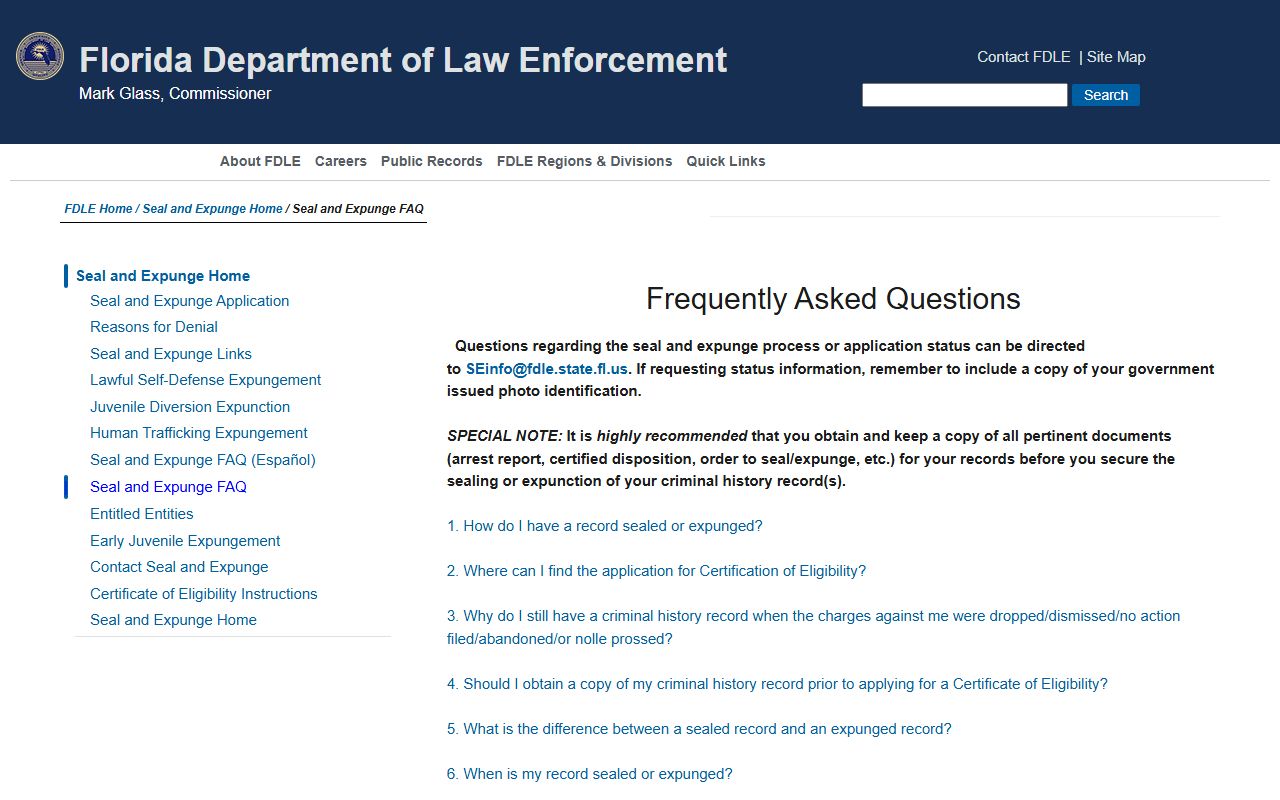
The FAQ also covers common denial reasons, such as a prior conviction or a disqualifying offense. The general path runs in this order.
- Apply to FDLE for a Certificate of Eligibility and pass the eligibility review under 943.0585 or 943.059.
- Wait for FDLE to issue the certificate, which confirms the record can move forward.
- File the petition, a sworn affidavit, the FDLE certificate, and a proposed order in the Pasco court that handled the case.
- Pay any filing fees unless they are waived, then serve the State Attorney and other required agencies.
- If the judge grants the order, the agencies seal or expunge the record as the order directs.
Common reasons for denial include a prior conviction or adjudication, a disqualifying offense, a past seal or expunge, pending charges, or filing in the wrong court. Some licensing and employment settings may still require disclosure or keep limited access.
Background Check Considerations
A casual name search on the jail roster is not a background check. A true background check for hiring, housing, or credit is governed by the federal Fair Credit Reporting Act and must run through a licensed consumer reporting agency. Pulling a Pasco arrest from the public roster tells you about one booking. It does not tell you whether the charge held up, whether the record was sealed, or whether the person was even the right match. For employment or tenant screening, use a proper FCRA-compliant provider.
Important: This site is not a consumer reporting agency under the FCRA, and its data may not be used for credit, employment, tenant, or insurance decisions.
Restricted Criminal Records in Pasco County
Not every arrest or criminal record is open. Juvenile justice records are restricted under Florida Statutes 985.04, and access is usually limited to parties, attorneys, agencies, or a court order. Sealed and expunged records under 943.059 and 943.0585 drop out of the public view by court order. Some personal data is stripped from public copies as well: social security numbers, bank and card account numbers, and certain protected addresses come out under Florida Statutes 119.071.
Records tied to an open investigation can also be held back until the matter closes. A booking may appear on the jail roster while the wider case file stays partly shielded. If a record you expect to find does not show online, it may be restricted by statute, sealed by order, or simply not yet entered. For active orders and capias events, the Pasco County warrant records page covers how warrants and bench warrants show up in the case docket.